Cannabis chemistry goes far beyond just the percentages of THC and CBD. Today’s buyers are into specific effects, and hence it’s important to understand the detailed chemical composition of these plants. By understanding how cannabinoids and terpenes jointly interact, lifestyle brands can cater more efficiently to their client base. When smoke shops offer accurate chemical profiles on their 420 packaging, producers will win the trust of buyers, who are looking for specific wellness or recreational effects.
Cannabinoids: The Main Elements
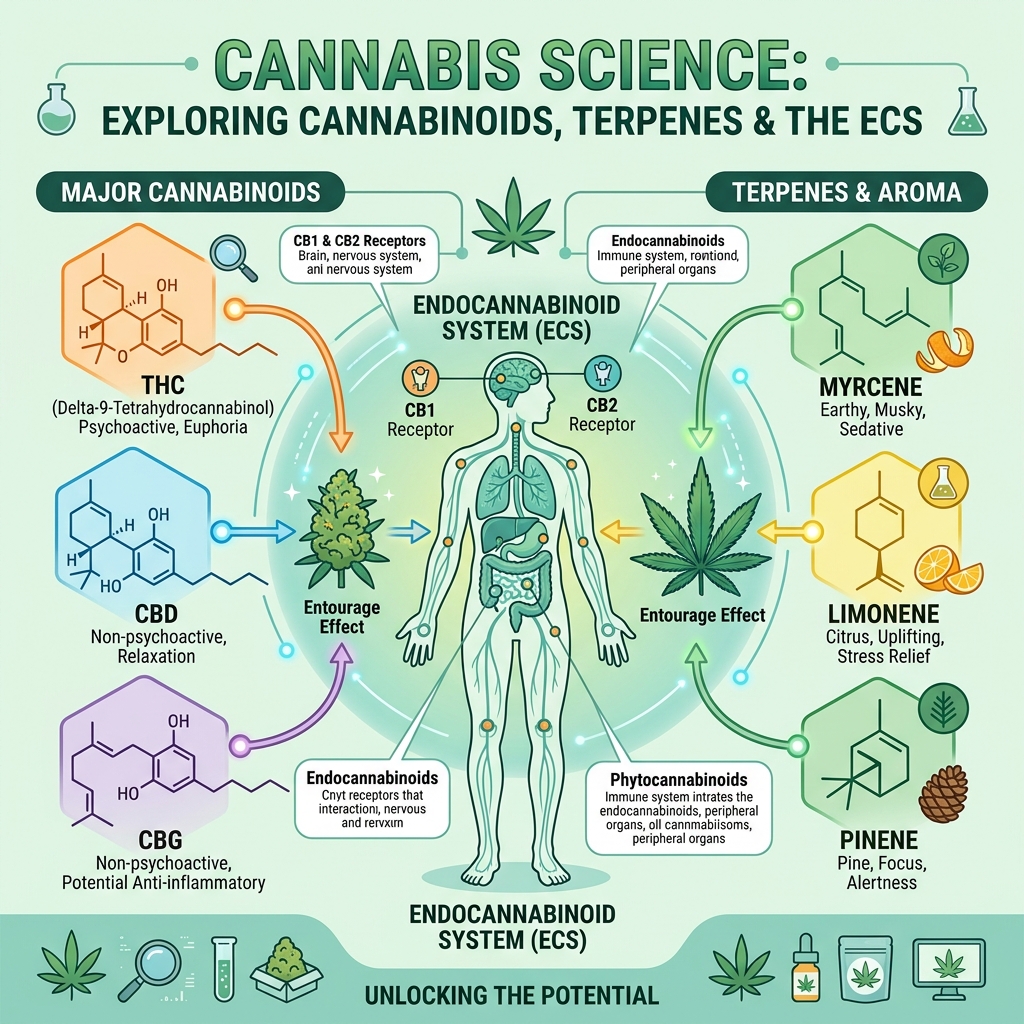
These chemical substances bind to the human endocannabinoid system, producing combined physical and psychological effects. Though the psychoactive experience is primarily delivered by Tetrahydrocannabinol (THC), Cannabidiol (CBD) is the source of non-intoxicating therapeutic effects.
Therapeutic use of minor cannabinoids is the focus of recent studies. Cannabigerol (CBG) is a potential anti-inflammatory agent, whereas Cannabinol (CBN) is most commonly associated with sleep support. Cannabichromene (CBC) is another cannabinoid that is involved in alleviating pain. Since customers are demanding such minor components more frequently, it is good business practice to include them explicitly on 420 packaging.
Terpenes: The Fragrant Creators
These organic compounds are responsible for the unique smells and tastes that differentiate one strain from another. Besides, they crucially contribute to the entourage effect, which is the idea that the cannabis compounds have a stronger effect when they are together.
The majority of product formulations include four main terpenes:
- Myrcene: A dominating note of earth, which is powerfully relaxing.
- Limonene: A citrus-flavored terpene with a usually uplifting effect.
- Pinene: The scent of this terpene is pine-like, and it probably helps with alertness.
- Caryophyllene: A peppery terpene that directly interacts with the cannabinoid receptors.
Some brands are going a step further, using their 420 packaging to illustrate terpene profiles clearly.
The Synergy of Science and Product
It is the producers that really have to figure out how to give consumers a certain feeling by tweaking the cannabinoid and terpene ratios. Nowadays, strain-specific testing has become an absolute requirement, not just an indulgence. The scientific method goes straight to the heart of product design, which is how lifestyle cannabis brands manage to set themselves apart.
As an illustration, a product that aims to induce sleep might use a combination of CBN and myrcene. To achieve effective communication of this product’s formula, the production team designs 420 cannabis packaging that incorporates soothing colors and easy-to-read fonts. Apart from that, cannabis 420 packaging is one of the ways through which the company expresses itself to the customer. Accessory brands and smoke shops can establish a trustworthy and cohesive brand image by aligning their cannabis 420 packaging with these scientific facts.
Introducing Knowledge into the Consumer Experience
Plant science knowledge helps consumers to pick the products that correspond to the effects they want. Responsible consumption is encouraged through education, and in this way, users can find the dosage that fits their needs the best.
Personalized experiences will become the norm as research keeps unveiling new hitherto unknown facts. Companies that are ready for this transition use cannabis 420 packaging as an important means of communication. Through unambiguous and well-thought-out labeling, potential buyers – young people and wellness seekers – are led to the most suitable products for their lifestyles.
A Full Spectrum Approach to Cannabis
The major elements of cannabis, cannabinoids and terpenes, are what make the flower really work. As science brings out the details of these compounds, the cannabis industry will develop new products as an inevitable consequence. Leading these developments means consistently building good products and being open and honest in marketing. By infusing very detailed chemical profiles in artful cannabis 420 packaging, lifestyle brands can cater to a more knowledgeable customer base as well as provide great value to them.